Market Dispatch

Markets move fast. Here’s what it means for your payments. 

Currency swings, rate changes, and new regulations can raise your costs before you see them coming. Our monthly Market Dispatch breaks down what’s moving in global markets and what it means for the payments you send and receive. 

Tightening For All

October was the mirror image of September. The loonie led at +1.87%, followed by the franc +1.32%, the Aussie +1.26% and sterling +0.94%; the kiwi (−0.11%) and yen (−0.11%) were flat, and the euro brought up the rear at −1.52%. October was the month the dollar gave it back. Market Review USD: The USD started October as the trade and ended it as the fade. September CPI was in line on headline (3.7% y/y) with a hot core (2.6% y/y vs 2.5% expected), and PPI hotter still (6.3% y/y). Hike odds ...
market-dispatch-october-edition

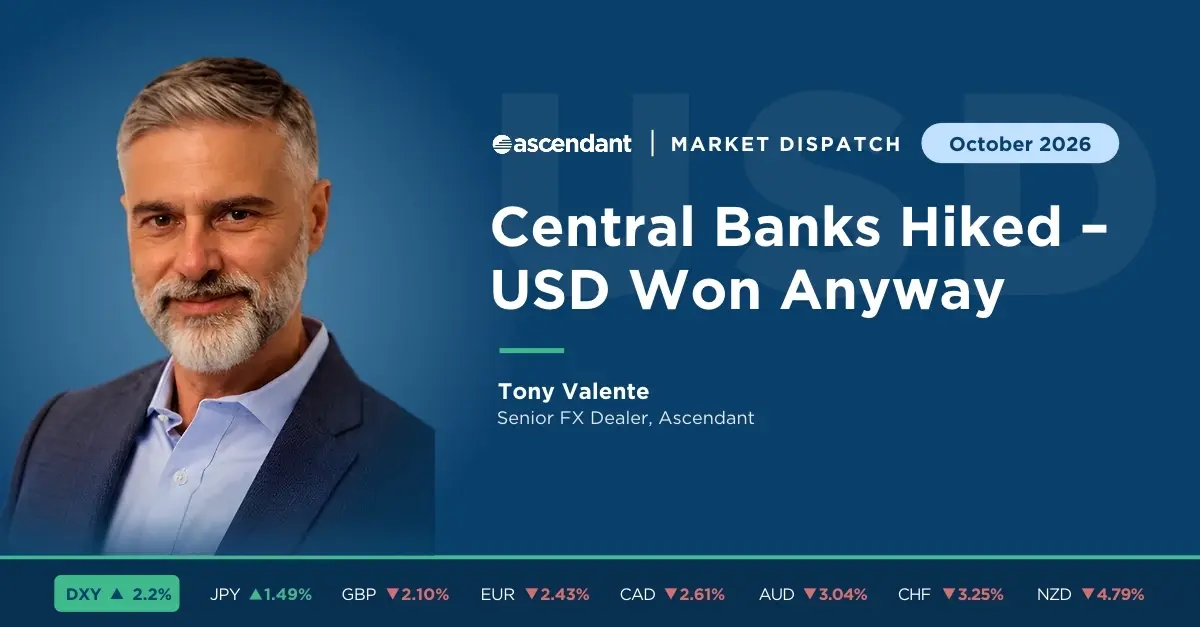
Central Banks Hiked – USD Won Anyway

September was the USD’s month, and among the majors covered here the scoreboard was almost a clean sweep. The US index rose roughly 2.2% to 101.19, bouncing from a September low near 98.4 and finishing within reach of July's highs around 101.5. The yen was the lone gainer at +1.49%. Everything else fell: sterling -2.10%, euro -2.43%, loonie -2.61%, Aussie -3.04%, franc -3.25%, and the kiwi dead last at -4.79%. It was a near-mirror of August, when every G10 currency rose, the kiwi led at +3.81%, ...

Bessent's Bargain: Bonds Saved, Dollar Sacrificed

August opened with commodity currencies ripping higher and the dollar bleeding out across the board. The final month-to-date chart shows the rally has moderated but the greenback remains on the defensive. The real story broke on August 19, when Treasury Secretary Scott Bessent doubled liquidity-support buybacks in the 10- to 20-year and 20- to 30-year sectors from $2 billion to at least $4 billion per operation. The 30-year yield dropped 8–10 basis points, gold surged 4.3% to $4,525/oz, and the ...

market-dispatch-august-edition

Warsh's Hawkish Bluff

The USD was mixed against the G10 for most of July before selling off sharply in the final week, leaving the DXY roughly 1.6% lower month-to-date. The New Zealand dollar led the field, rallying 3.81% against the greenback, followed by the Japanese yen at +2.80%. The Australian dollar and sterling gained 1.74% and 1.72% respectively, while the Canadian dollar added 1.28%. The euro managed a 1.01% advance, and the Swiss franc barely budged at +0.09%. The late-month sell-off was less about a ...

market-dispatch-july-edition

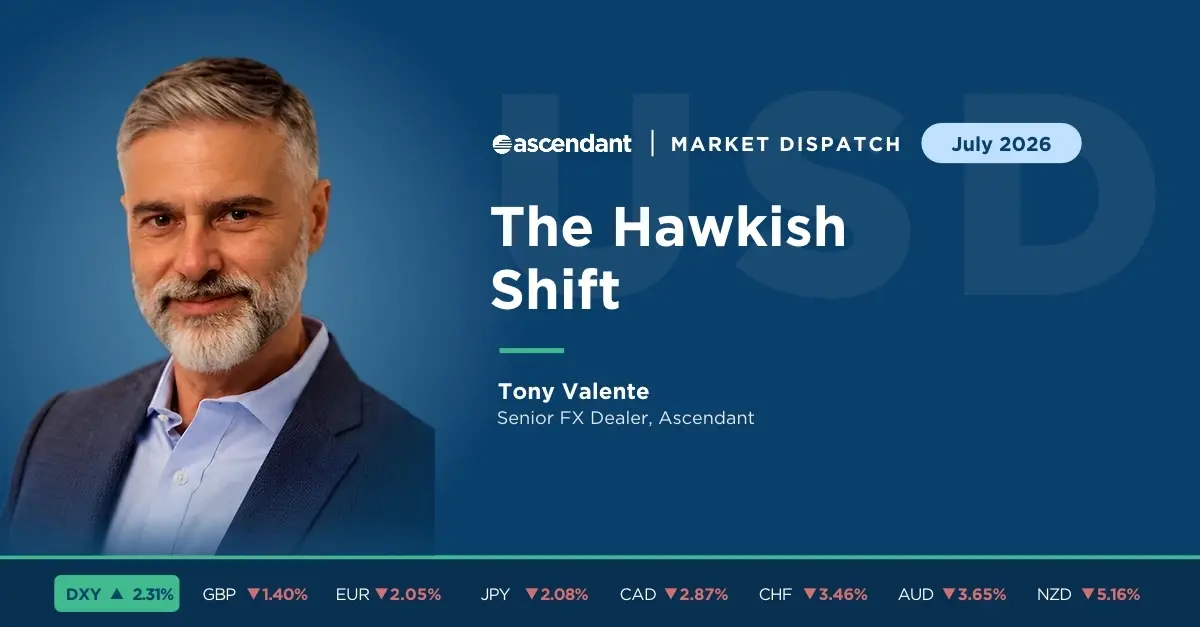
The Hawkish Shift

The greenback dominated June, extending its broad rally and leaving the G10 complex in its wake. As the attached chart illustrates, the USD appreciated against every major peer on a month-to-date basis. The Dollar Index broke above 100 and touched a one-year high, fueled by Kevin Warsh's hawkish pivot at the Fed. His first FOMC meeting produced the largest hawkish surprise among 57 events tracked by the San Francisco Fed since January 2020, a notably terse statement stripped of forward ...

market-dispatch-may-edition

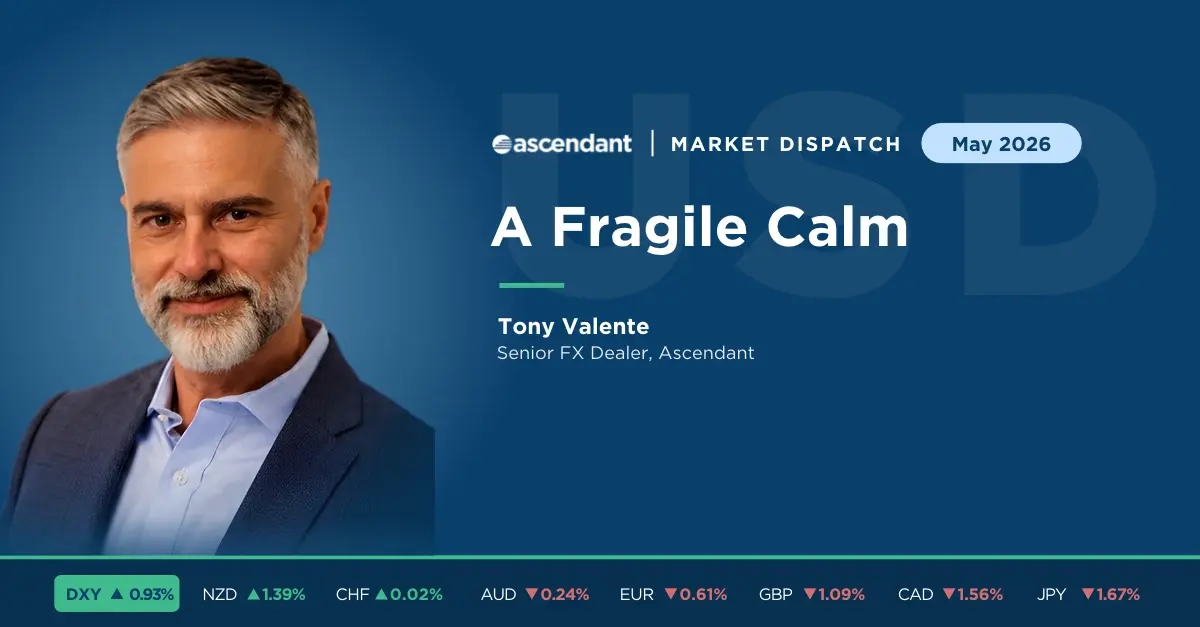
A Fragile Calm: US Resilience, Fed Transition, and the Search for Direction

The month of May has delivered a textbook example of a market caught between relief and residual anxiety. The NZD has emerged as the clear outperformer, gaining 1.39% against the greenback, while the JPY and CAD have lagged, down 1.67% and 1.56% respectively. The CHF and USD itself have barely budged, with the franc up just 0.02% and the USD flat against its own benchmark. The AUD has softened by 0.24%, the EUR by 0.61%, and sterling by 1.09%. This dispersion tells a story of commodity-linked ...

market-dispatch-may-edition

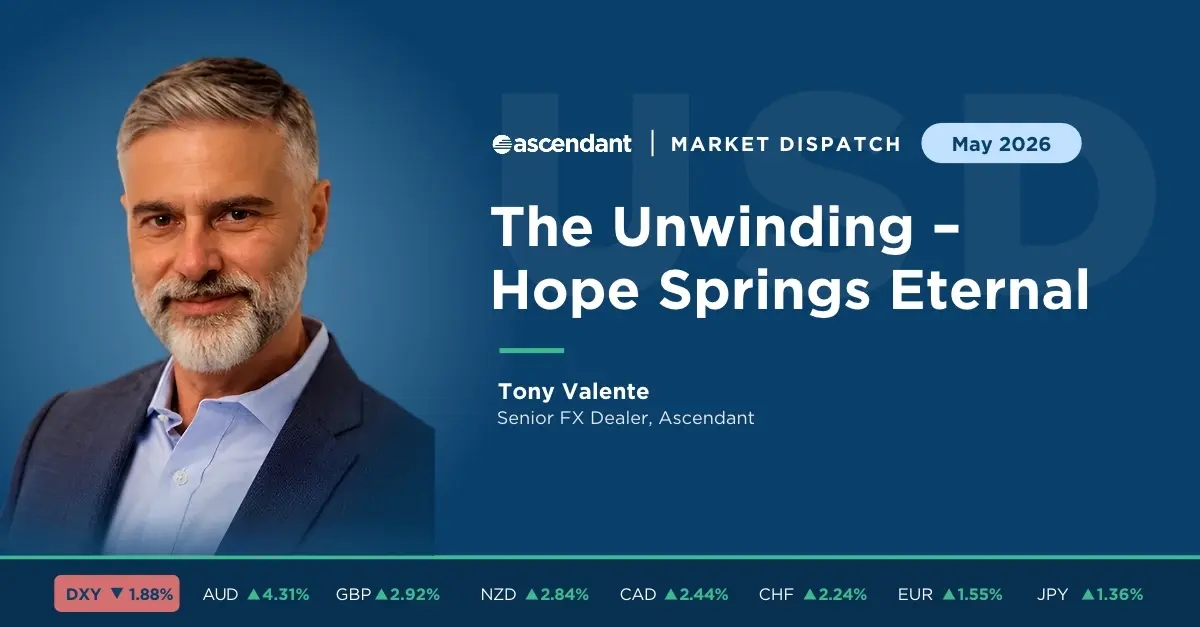
The Unwinding – Hope Springs Eternal

April was a month of transition and retracement as the March risk-off/war premium reversed alongside a sharp collapse in market-priced rate hikes. The USD, which had rallied sharply in March on the back of the Middle East war and a repricing of Federal Reserve expectations, gave back a significant portion of those gains as optimism about a negotiated settlement took hold. The Dollar Index fell for three consecutive weeks, its longest losing streak in a year, and briefly traded below 97.65, its ...

The FX Paradox – Safe Haven or Structural Shift

The USD has strengthened sharply through the final week of March, with month-to-date gains extending across all G10 currencies. The outbreak of hostilities between the US and Iran on February 28 initially triggered a classic flight-to-safety bid, but the rally has gathered momentum as Treasury market dysfunction and diverging central bank outlooks have reinforced dollar dominance. The GBP has proven the most resilient, declining 1.66% against the greenback, supported by a hawkish repricing at ...

Tariffic Supreme

As we close the books on February, the currency markets have finished the month in a state of stark divergence. The Australian Dollar emerged as the undisputed leader of the G10 complex, surging 2.13% against the Greenback to finish the month at 0.7110. This outperformance was solidified following the Wednesday, February 25, release of a firm January CPI print, which significantly boosted market confidence in a May rate hike by the Reserve Bank of Australia. This data sent the Aussie climbing ...

The Davos Revolt and the Warsh Rescue

Before diving into the geopolitical shifts at Davos, we must look at the scoreboard. January was a rare unanimous month where every major currency gained significant ground against the USD. While the USD’s “benign neglect” provided the baseline, these specific factors amplified the moves: The Antipodean Alpha (AUD & NZD) The Australian and New Zealand Dollars were the clear winners this month. AUD: Despite no formal meeting in January, the Reserve Bank of Australia (RBA) was forced into a ...

Year-End Report Card

2025 delivered a broad-based setback for the USD, which declined against all major currencies. Year to date, the greenback is down 14.46% against the Swiss franc, 13.36% against the euro, 7.81% against the Australian dollar, 7.54% against the British pound, 4.81% against the Canadian dollar, 2.86% against the New Zealand dollar, and 0.30% against the Japanese yen. This decline reflects resilience in foreign economies, a recalibration of safe-haven demand, and a shift in global interest rate ...

Cut Skip or Pause - Ascendant International Payments

The broad based USD, represented by the US dollar index has been up only since September 30th. It has been up for 8 straight weeks until last week. When the USD is up only it gets reffered to a “wrecking ball” and for good reason, it can have profound, often negative, effects on global economic stability, akin to a wrecking ball swinging through international financial structures. The term “wrecking ball” metaphorically suggests that while the USD’s strength might seem beneficial or stabilizing ...

The Softwar

As a foreign exchange dealer attuned to the Fed’s every whisper, November 2025 illustrated how quickly the USD’s momentum can reverse. The Dollar Index (DXY) slipped from 100.33 to 99.43 as early-month strength was undone by dovish signals and an aggressive repricing of December rate-cut expectations. Most major currencies rebounded from October’s USD surge, with the notable exception of the JPY, which weakened 1.36% to 156.13 per USD amid persistent yield differentials. The USD’s choppy path ...

QE – Not QE

The USD extended its dominance in October, rising against all major currencies as markets recalibrated expectations for global growth and monetary policy. Japan made history when the Liberal Democratic Party selected Takaichi Sanae as its new leader, the country’s first female prime minister. Takaichi has endorsed the LDP’s long-standing mix of easy monetary policy and aggressive fiscal stimulus, a stance that initially reassured equity markets but weighed heavily on the yen, which fell roughly ...

Divergence, Debt, and Shifting Safe Havens

As September draws to a close, the foreign exchange markets have navigated a turbulent landscape shaped by diverging central bank policies, rising bond yields, and mounting U.S. fiscal pressures. The U.S. dollar (DXY) has logged a steep year-to-date decline of more than 10.7% against the DXY basket—the weakest start since 1986—but managed a modest 0.5% gain this month despite the Federal Reserve restarting its rate-cutting cycle. The index has stabilized around 102.50, its softest level since ...

The Dollar Loses Its Shine

August was turbulent for currency markets, with the US dollar weakening against nearly all major peers as the Federal Reserve signaled a pivotal shift in monetary policy. The lone exception was the New Zealand dollar, pressured by falling dairy prices—whole milk powder auctions slipped 3%—and the RBNZ’s forecast for earlier rate cuts amid unemployment climbing to 5.1%. The driver of USD weakness was the Fed. While no FOMC meeting was scheduled in August, a series of developments confirmed a ...

“Fugazi” Dollar Rally

The U.S. dollar index (DXY) endured a volatile July, snapping a six-month decline only to reverse sharply after a dismal employment report. From January through June, the DXY fell nearly 10.8%, but rebounded 2.0% early in July following stronger-than-expected nonfarm payrolls data. However, the rally quickly unraveled, with the index dropping 1.23% to 98.80 on August 1 after July’s jobs report showed only 73,000 new positions—well below the 160,000 forecast. The whiplash mirrored the concept of ...

USD Mid-Term Report Card

The first half of 2025 has delivered a broad-based setback for the USD, which has declined sharply against all major currencies. Year to date, the greenback is down 14.38% against the Swiss franc, 14.19% against the euro, 9.90% against the British pound, 8.84% against the Japanese yen, 8.01% against the New Zealand dollar, 6.23% against the Canadian dollar, and 5.35% against the Australian dollar. This decline reflects a shift in global interest rate expectations, resilience in foreign ...

Bond’s Warning Sign

The U.S. jobs market remains robust, and uncertainty surrounding tariffs is causing the Federal Reserve to pause its actions. Meanwhile, most G10 central banks, except the Bank of Japan, are likely to cut rates before the Fed resumes easing. This should theoretically strengthen the USD against major currencies, yet the USD continues to weaken. Central banks control short-term interest rates, but long-term rates are market-driven, influenced by expectations of future central bank policies, ...

Liberation Day Aftermath

The opening words of last month’s letter couldn’t have been more fitting: “There’s no turning back now, and the rest of the world knows it.” The events that followed proved just how true that was. On April 2nd, “Liberation Day,” the reciprocal tariffs announcement felt less like true reciprocity and far more like raw protectionism. Instead of a measured response, tariffs were set at a weighted average of 24%, with expectations climbing toward 27% once Section 232 (national security tariffs on ...

Narrative Flip – Game Changer

There’s no turning back now, and the rest of the world knows it. The reciprocal tariffs set to be announced on Wednesday, April 2nd, won’t resolve uncertainty—they will merely mark the beginning. Whatever is unveiled will serve as the opening salvo of President Trump’s trade war. These tariffs will be subject to negotiation in the coming weeks, months, or even years. Furthermore, additional tariffs targeting specific countries (such as Venezuela and China) and industries (including lumber and ...

Growth Scare

The Japanese yen was the top-performing currency in February, appreciating by 3.05% due to a combination of rising Japanese interest rates and a decline in U.S. 10-year interest rates. As illustrated in the chart above, the USD weakened against the yen, dropping from approximately 159 in early January to around 148.55 by the last week of February—its lowest level since October. This yen strength is attributed to expectations that the Bank of Japan will continue normalizing monetary policy ...

Deep Tariff Uncertainty

The CAD was the weakest performer in January, pressured by a rate cut from the Bank of Canada and renewed tariff threats from President Trump. In contrast, Japan saw the opposite trend—the Bank of Japan raised interest rates, and the absence of U.S. tariff threats helped the yen strengthen 1.45% against the USD over the month. Market sentiment quickly shifted from concerns over China’s DeepSeek AI to uncertainty surrounding tariffs. On Friday, the White House announced that President Trump ...

Mar-a-Lago Accord

At the start of 2024, market consensus widely predicted that the U.S. Federal Reserve would slash interest rates six times, with speculation rising to as many as seven cuts by mid-January. A recession, deemed imminent, was expected to drive this aggressive monetary easing. However, as 2025 begins, those forecasts appear vastly overstated. Inflation has proven more persistent than anticipated, and now the debate centers on whether the Fed might manage even two rate cuts this year. How quickly ...

Global Liquidity Bazooka

The long-anticipated move has finally happened— the Federal Reserve kicked off the monetary easing cycle with a larger-than-expected 50 basis point rate cut, instead of the predicted 25 bps. But that’s just the beginning. The updated Dot Plot now projects eight more rate cuts by the end of 2025, up from the five expected in June, marking a significant downward revision that aligns more closely with market expectations. With this move, the Fed becomes the seventh G10 central bank to cut rates ...